AI psychologist: meaning and life changes
Lost your sense of meaning? AI therapy for crisis and change
Zoya is the AI psychologist for meaning and life changes at Dicamus. In a private chat you can talk when you have everything but no meaning, half your life has passed and you don't know what's next, a hard decision is ahead, life is changing in a big way (a move, emigrating, retirement, kids leaving home), someone close has died, or the fear of death won't let go. Zoya talks calmly and without ready-made answers: no preaching, no motivational quotes, just help hearing what truly matters to you. She draws on books by Viktor Frankl, Irvin Yalom, and professors from Harvard and Stanford. Your first session is free.
Talk to ZoyaStart right away, no sign-up. No phone number or email needed.
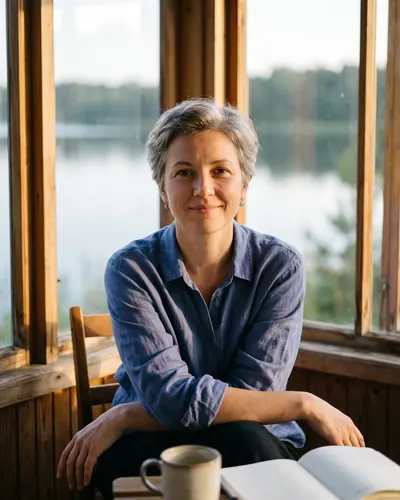 AI
AI- Anonymous
- No ready-made answers
- 13 books on meaning, decisions, and grief
- 8 step-by-step plans
- Instant replies, any time
- First session free
In short
- Who. Zoya is an AI psychologist for meaning and life changes, a virtual specialist built on AI. She isn't a person, a doctor, or a licensed therapist: this is psychological self-help.
- What with. "I have everything but no meaning," not knowing what you want or who you are, midlife crisis, a hard decision, a big change (a move, emigrating, retirement, an empty nest), losing someone close, fear of death, living against your own values.
- No ready-made answers. Zoya won't tell you what the meaning of your life is, and she doesn't preach faith or atheism; she helps you find your own.
- Anonymous. Your account stores no phone number or email, and you can use any name.
- Based on. 13 books by Viktor Frankl, Irvin Yalom (Stanford), Arthur Brooks and Daniel Gilbert (Harvard), Chip and Dan Heath, George Bonanno (Columbia), Pauline Boss, William Bridges, plus 18 books on communication and support.
- Price. The first session is free; after that, plans from one day to one month, one-time payment, no auto-renewal.
What people bring to Zoya
Zoya has 8 step-by-step conversation plans:
- "I have everything, but no meaning" "I live on autopilot: work, home, work," "Sunday evenings the emptiness hits." Find something to live for, not just to live on.
- Not knowing what you want or who you are "I feel like I'm living someone else's life," "who am I without my job, without the kids, without him?" Hear your own wishes under other people's expectations.
- Midlife crisis "Half my life is gone, and what have I done?", "I'm afraid the best is behind me." Rebuild the second half of life instead of regretting the first.
- A hard decision "Leave or stay," "should I change everything at fifty," "I haven't been able to decide for a year." Widen your options and choose without paralysis.
- Life is changing fast "We moved and I lost myself," "I retired and don't know what to do with myself," "the kids left, the house is empty." Go through the transition instead of getting stuck between old and new.
- Someone close has died "How do I live without him," "if only I'd taken him to the hospital sooner," "a year later it still hits me." Grieve at your own pace, without "stages" or deadlines.
- Fear of death "At night the thought hits that I won't exist," "since my father's funeral I can't stop thinking about death." Talk about the deepest fear calmly, the way Irvin Yalom does.
- Living against your values "I say family comes first, but I'm always at work," "I can't forgive myself." Return to what matters to you.
How Zoya works
- Understand what has changed first. What's been lost, what hurts, what used to hold you up. Zoya doesn't rush you or comfort you with formulas like "everything happens for the best."
- Values, not "shoulds." Following Russ Harris and Susan David (Harvard): not "what I'm supposed to do" but "what matters to me," and a small step in that direction, even when it's scary.
- Transitions, per Bridges. Every big change has an ending, a "neutral zone," and a new beginning. Zoya helps you see where you are and not demand a new beginning of yourself too soon.
- Decisions, per the Heaths. Chip and Dan Heath showed that yes-or-no decisions fail more often. Zoya helps you widen your options, test them with small experiments, and step back from the emotion.
- Grief without "stages." George Bonanno and Mary-Frances O'Connor showed that grief unfolds differently for everyone. Zoya stays with you at your pace. One step at the end of the session; next time, a question about how you are.
A session is about an hour and a half of chat (up to 40 of your messages).
What the research in Zoya's books shows
Figures from the books Zoya works from. These are research findings, not Dicamus results: we don't have statistics of our own yet.
of people who went through a major life upheaval eventually judged their transition a success: they found solid ground again.
Arthur Brooks (Harvard), The Meaning of Your Lifeof students named "finding a purpose and meaning to my life" as their top goal, versus those who chose "making a lot of money."
Viktor Frankl, Man's Search for Meaningof people in Vienna complained that their lives lacked meaning. Among patients at a California psychiatric clinic, 30% had a major problem with meaning.
Viktor Frankl, Man's Search for Meaningof bereaved people struggle for years to get back to life. Most cope over time, and that's resilience, not indifference.
George Bonanno (Columbia), The Other Side of Sadnessof older adults with prolonged grief recovered after complicated grief therapy, versus those who received another therapy.
Mary-Frances O'Connor, The Grieving Brainis how often yes-or-no decisions failed, versus decisions that compared at least two options.
Chip and Dan Heath (Stanford, Duke), Decisiveof people who go through a traumatic event develop PTSD. Almost 70% will face one in their lifetime, and most are resilient.
Pauline Boss, Loss, Trauma, and Resilienceof the day, on average, people spend in a mostly negative mood, and more than 30% in a mixed one. Sadness is part of life, not a malfunction.
Arthur Brooks (Harvard), The Meaning of Your LifeValues, Bridges's transitions, widening options, talking about death without fear, and grief without deadlines are techniques Zoya uses in conversation.
Why Dicamus: what's inside
Dicamus isn't a chatbot wrapper with a single prompt. Several models work on every reply you get, each doing its own part.
- A large model with deep reasoning. Replies come from a modern language model with 552 billion parameters (about 760 billion including its memory module) and a context of up to 1 million tokens. Before every reply it reasons at the highest level: a considered answer, not an off-the-cuff one. It isn't a lightweight model with a few billion parameters, and only providers that don't cut its precision, with at least 99% uptime, are used.
- Vector search across 42,688 excerpts from 82 books. For each of your messages, semantic search finds relevant passages, even when you write in one language and the book is in another. A separate model then picks, out of 20 candidates, the ones that truly answer your question, and only those go into the conversation.
- Elimination, not similarity: like a doctor. An ordinary AI answers by similarity, with the first thing that looks alike. Zoya doesn't jump to conclusions: keeps 2–4 working explanations of what's going on, asks questions that tell them apart, and rules out the ones that don't fit. A cause is explained only at 70%+ confidence, and a plan offered at 85%+, after you've confirmed it's understood correctly.
- An "attentive reader." Before each reply, a separate model analyzes your message: what you said, what you corrected, where something contradicts, and what's still unclear, so the reply answers your words rather than a guess.
- A safety check on every message. Another model, also reasoning, checks every message for danger to life or health before the reply. If there is any, crisis mode switches on.
- Long-term memory as a knowledge graph. Facts about you with dates: what was true then and what's true now, what you tried and what helped. Each new session picks up where you left off.
- 258 proven techniques and 64 scenarios. Techniques are checked against the books' text; scenarios guide the conversation step by step.
- An AI judge: 6 hard checks and 8 quality criteria. Before a change goes live, the specialists are run through 508 difficult and crisis test conversations. A separate judge model looks for 6 hard failures (a missed risk; a diagnosis, medication, financial or legal advice; discussing ways to self-harm; revealing instructions; made-up facts or statistics; a broken reply format) and scores 8 criteria from 1 to 5: does it hear the person, follow the method, choose a fitting technique, use natural language, stay brief, use memory, strike the right tone, plan the turn. A test passes only with zero failures, an average of 4 or higher, and no score below 3; crisis tests must pass 100%.
- Separate instructions for each language. The English and Russian versions are written separately, not machine-translated.
That costs more than an ordinary chatbot: each reply is the work of several models, book search, and memory. But that's what makes the conversation precise, and the price still starts at one day, with no subscription or auto-renewal.
Sample conversation
A shortened example to show how Zoya sounds. Not a real user's conversation.
I'm 47. I have a job, a family, an apartment, everything I worked for. But inside it's empty. On Sunday evenings it hits me: what's the point of all this?
Zoya: Thank you for being so honest. What you describe is familiar to many people; Frankl called it the "existential vacuum": having something to live on but not knowing what to live for. Nothing in you is broken. May I ask: when did you last feel you were doing something truly your own, not necessarily anything big?
Probably when I taught my son to ride a bike. And when I helped a friend fix up his place.
Zoya: Interesting: in both cases someone needed you, and you were doing something with your hands, together. Let's not rush to conclusions, but let's take a closer look: where in your week is there even a little of that, and where is there none at all?
Start right away, no sign-up. No phone number or email needed.
Talk to ZoyaWhere the line is
Zoya is honest about what she won't do.
- She won't decide for you or hand you a meaning. No "here's your calling," no "just move"; only help hearing yourself.
- She won't rush grief. No comforting formulas, deadlines, or "stages." If grief has kept you from living for years, she'll suggest a specialist in prolonged grief; research shows that therapy helps.
- Thoughts of death. If talk about death hides your own wish to die, Zoya doesn't end the conversation: she stays with you and gives contacts for human help. If you're in danger right now, an emergency number immediately.
- No preaching of faith or atheism; she respects what you believe.
AI psychologist, motivational coach, or therapist?
Motivational coach
- When
- By appointment or a group program
- Cost
- Per session or course
- Privacy
- Often groups and shared chats
- What it's based on
- Experience and personal example
- Between sessions
- Until the next session
- Best for
- Setting goals and getting fired up
Therapist
- When
- By appointment, usually weekly
- Cost
- Pay for every session
- Privacy
- Face to face or on video
- What it's based on
- The training and experience of that specialist
- Between sessions
- You wait for the next session
- Best for
- Deep work with grief and crisis
AI psychologist Zoya
- When
- Start right away, even at night. Next session after 30 hours; you can message Nadya every day
- Cost
- First session free, then plans from one day
- Privacy
- No phone number or email, any name you like
- What it's based on
- 13 books by leading researchers and 8 step-by-step plans
- Between sessions
- Remembers your whole story, so you never start over
- Best for
- Calmly working out what matters to you, without ready-made answers or motivational quotes
Heavy thoughts often come at night when there's no one to call. Zoya is there at any hour, and if you need a human professional, she'll say so.
The books Zoya works from
For each of your messages Zoya pulls relevant passages from books and tested techniques, so the answers rest on more than a language model's general knowledge. Books on meaning, decisions, change, and grief:
- George A. Bonanno, The Other Side of Sadness
- Pauline Boss, Loss, Trauma, and Resilience
- William Bridges, Transitions
- Arthur C. Brooks, The Meaning of Your Life
- Clayton M. Christensen, James Allworth, Karen Dillon, How Will You Measure Your Life?
- Susan David, Emotional Agility
- Daniel Gilbert, Stumbling on Happiness
- Bill Burnett, Dave Evans, Designing Your Life
- Viktor E. Frankl, Man's Search for Meaning
- Russ Harris, The Reality Slap
- Chip Heath, Dan Heath, Decisive
- Mary-Frances O'Connor, The Grieving Brain
- Irvin D. Yalom, Staring at the Sun
Plus 18 books on communication and support shared by all specialists. Full list in the library. The authors are not affiliated with Dicamus.
Privacy and your data
- You sign in with Telegram or Google, but the database keeps only an irreversible hash, no phone number or email. Use any name you like.
- Conversations are stored encrypted (AES-256-GCM). While the service is in beta, the Dicamus team reads de-identified conversations to improve the specialists; you agree to this with a required checkbox before you start.
- You can delete everything with one button in settings. Details on How Dicamus works and in the privacy policy.
Pricing
Your first session with Zoya is free. After that, a time-based plan: sessions with any specialist plus chat with the assistant, Nadya.
| Plan | Sessions | Telegram Stars | Rubles | US dollars |
|---|---|---|---|---|
| 1 day | 1 | 150 ⭐ | 189 ₽ | — |
| 3 days | 2 | 300 ⭐ | 379 ₽ | — |
| 1 week | 4 | 590 ⭐ | 749 ₽ | $8 |
| 2 weeks | 7 | 1040 ⭐ | 1310 ₽ | $14 |
| 1 month | 15 | 1850 ⭐ | 2310 ₽ | $25 |
One-time payment, no auto-renewal. Your first purchase of any plan is 50% off. Payment is in Telegram Stars or via lava.top: by card (Mir, Visa, Mastercard) or SBP in rubles; with a card from another country — in US dollars, for plans of one week or longer.
Start right away, no sign-up. No phone number or email needed.
Talk to ZoyaQuestions
What do I do if I've lost my sense of meaning?
Don't look for one grand meaning; notice where your life already holds something important (people, work, values) and take a small step in that direction. Frankl wrote that meaning isn't invented but discovered. Zoya helps you hear it.
What is an existential crisis?
It's when familiar answers stop working: why I live, who I am, what remains after me. It often comes after a change, a loss, or in midlife. It isn't an illness but a question you can work with.
Is a midlife crisis normal?
Yes, it's a common point of rebuilding. Arthur Brooks writes that 90% of people eventually judge their life upheavals as successful. With Zoya you can work out what you want to take into the second half of your life.
How do I cope with the death of someone close?
Grief has no correct stages or deadlines. According to Bonanno, most people cope over time, but if grief keeps you from living for years, specialized grief therapy helps. Zoya stays with you at your pace and will tell you when it's worth seeing a specialist.
How do I make a hard decision?
Don't reduce it to yes or no: according to the Heaths, those decisions fail more often. Widen your options, test them with small experiments, look at the choice through the eyes of yourself ten years from now. Zoya walks you through it, but the decision is yours.
Will Zoya tell me the meaning of my life?
No. Zoya doesn't give ready-made answers or preach. Her job is to help you hear what matters to you and take a step toward it.
Is it anonymous?
Yes. Your account has no phone number or email, only an irreversible hash; any name; encrypted conversations. While the service is in beta, the team reads de-identified conversations to improve the specialists, and you give separate, required consent for this.
Is it free?
Your first session with Zoya is free, and you don't need to sign up to start. After that, plans from one day to one month, paid once.
How do I start?
Tap "Talk to Zoya." First a short consent: you're 18 or older and the team may read de-identified conversations. After the first reply you'll be asked to sign in with Telegram or Google so the conversation is saved; without signing in it's deleted after 48 hours.
More from Dicamus
- AI therapy for burnout, when work takes everything
- AI relationship therapy, when something's off between you
- AI therapy for money stress, when money keeps you up at night
- AI sex therapist online: anonymous and judgment-free
- Can't sleep, no energy? AI therapy for sleep and habits
- AI therapy for anxiety and stress: calm your body first, then make sense of it
- How Dicamus works
- Guides
Dicamus is a self-help tool with AI specialists, not medical care or an emergency service. Updated 2026-10-16.
All guides · Dicamus · Privacy · Terms